

Hybrid Nest Clay Core, M (100 x 100 mm)
Sizes S, M, L and XL
£19.99 £15.99 Pre-order
Black Friday / Cyber Monday sale, ends Sun 6 Dec
The Hybrid Nest with the Antkit Ceramic Core, in sizes S, M, L and XL. Sizes M, L and XL come with a mesh lid with a red feeding plug, so air gets in and ants stay in, and a transparent lid as well. If you would rather have no lid, choose No lid and the top is solid clear acrylic instead. S has no lid; the top is solid clear acrylic.
The Ceramic Core is made in production runs, like our ceramic nests. First stock is early December 2026.
Details
- M, L and XL come with a mesh lid with feeding plug and a transparent lid (or choose no lid)
- Antkit Ceramic Core
| S | 120 x 50 mm | |
|---|---|---|
| M | 100 x 100 mm | |
| L | 100 x 200 mm | |
| XL | 200 x 200 mm | |
| With both lids | AK-HNC-S1 | £15.99 |
| No lid (solid clear acrylic top) | AK-HNC-S1-NL | £15.99 |
Built into every nest

What the Clay Core is
The Clay Core is the heart of this nest: a single piece of fired earthenware. A flat plate sits in the water of the reservoir, and a raised block on top of it forms the floor of the wet chamber. It is left unglazed on purpose, because the clay has to stay porous. It is durable, chew proof and easy to clean: it lifts out, washes and drops back in, and if you ever need a new one it is a replaceable part. It is made in production runs alongside our ceramic nests.

How it keeps the chamber damp
Earthenware is porous. Water from the reservoir soaks up through the plate and into the block, and the surface of the floor stays damp. There is no mesh, no cassette and nothing that moves: the water travels through the clay itself. It is the same principle as the plaster and ytong nests keepers already know, in a fired ceramic. The moisture is in the floor, where the colony can reach it, and the dry end stays dry. Moisture control is excellent. The top of the floor carries a honeycomb relief, raised ribs round open cells, so it is textured ground rather than a flat slab.

Mesh lid and feeding plug
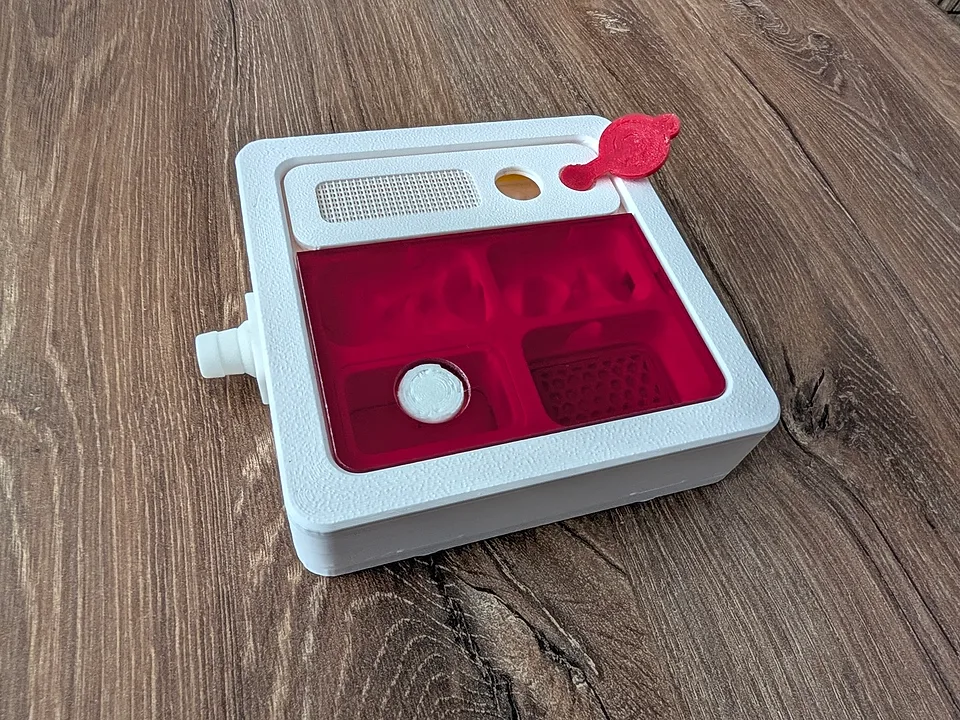
Sizes M, L and XL come with a mesh lid with a red feeding plug, so air gets in and ants stay in, and a transparent lid as well. Take the plug out, put the food in, push it back: you never have to open the nest to feed. If you would rather have no lid, choose No lid and the top is solid clear acrylic instead. S has no lid; the top is solid clear acrylic.

Removable red dust cover
A transparent red cover sits over the nest and keeps the dust off. Lift it off to see the colony in full colour.

Every nest has a landscape of its own
No two nests are the same. The ridges, terraces and columns on the chamber floors are made for each nest we build, and for each one you download from our Makers section.

Port shutters, hidden under the bezel
Colonies grow, and the ports are how the nest grows with them. Each expansion port has its own sliding shutter, and it sits under the bezel, so with the bezel on there is nothing to catch, flick or slide open by accident. Lift the bezel to open a port when the colony is ready for an arena or a second nest, and close it again when it is not. The ports take our sawtooth connectors and tubing.

Stainless steel fixings, out of sight
The acrylic top is held down with stainless steel M3 screws, and the bezel covers them, so no fixings show.

Warm end, dry end, damp end
A channel through the base takes a heater cable, and it runs under the dry end, so with a heater fitted the dry end is the warm end and the water stays at the wet end. A second channel takes a temperature sensor, so you can read the temperature instead of guessing. The heater and sensor are not included.
Anti-vibration feet
Four soft feet under the base stop the nest creeping and take up vibration from the surface it stands on.
Being made
The Clay Core is the ceramic part of this nest. These are the first ones, packed and going into the kiln for their first firing.


Turn it round
